Rock & Mineral Resources
Brazil's tectonic stability is also the source of its mineral wealth. The ancient, deeply eroded rock of the Brazilian Shield — a Precambrian craton over a billion years old — exposes iron-rich banded formations at the surface across Minas Gerais and Pará that elsewhere on Earth remain buried under younger rock. This geology makes Brazil one of the top mineral producers on the planet.
Iron, Niobium & Gems
The Carajás Mine in Pará is the largest open-pit iron ore mine on Earth, holding an estimated 7.2 billion tonnes of reserves alongside manganese, copper, and gold. Minas Gerais supplies about 60% of national iron output and, remarkably, roughly 90% of the entire world's niobium — a metal essential for high-strength steel used in pipelines, jet engines, and bridges. Minas Gerais also produces 74% of Brazil's gemstones, including amethyst, imperial topaz, tourmaline, aquamarine, and emerald.
Jobs, Exports & Trade Routes
Mining generated roughly $41 billion in production value in 2020 and directly employs over 170,000 Brazilians, with many more jobs in transport and processing. Ore travels the 892 km Carajás Railroad to the port of Ponta da Madeira for shipment mainly to China, along with Japan, Europe, and other Asian steelmaking economies.
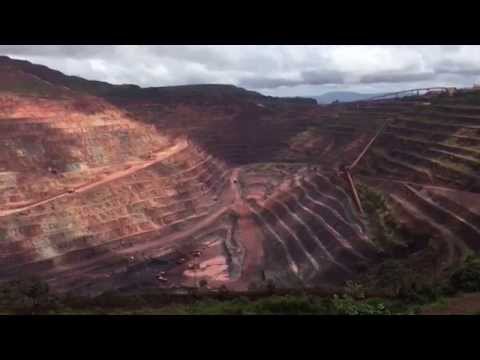 ►
Vast iron mine carved out of Brazil's forest
The Washington Post — watch on YouTube ↗
►
Vast iron mine carved out of Brazil's forest
The Washington Post — watch on YouTube ↗
An aerial look at the Carajás iron ore complex and its footprint on the surrounding Amazonian forest. Opens on YouTube in a new tab.
_2_(32248291843).jpg)
Amethyst Geode
Southern Brazil's basalt cavities host some of the world's largest amethyst geodes, a major export for the jewelry and decorative-mineral trade.
Why the Rock Runs Iron-Rich
The banded iron formations of Carajás and the Quadrilátero Ferrífero ("Iron Quadrangle") in Minas Gerais formed roughly 2.5 billion years ago, when dissolved iron in ancient oceans precipitated out as the atmosphere first became oxygen-rich — a geologic accident that now anchors an entire national industry.
Sources & References
- Minerals & Mining: Brazil's Mineral Resources (EBSCO Research Starters); USGS — Niobium and Tantalum Resources of Brazil; Carajás mine; Gemstone deposits of Minas Gerais (University of Waterloo).
- Mining Disasters: Scientific Reports — Brumadinho tailings dam disaster; Brumadinho Dam Disaster overview.
- Images: Wikimedia Commons — Amethyst geodes.
- Video: "Vast iron mine carved out of Brazil's forest" (The Washington Post).